The Complete Nutrition Reference

You've been getting your nutrition advice from 60-second videos. Some of them lied to you.

Some of it is right. Some of it is wrong. And almost all of it sounds equally convincing.

Just Eat Right gives you a way to tell the difference.

Not another diet. Not another list of foods to eat and avoid. A reference you can actually use, for when you're standing in the grocery aisle, looking at a label, ordering at a restaurant, or wondering whether the latest thing you heard is actually true.

Just Eat Right on desktop, tablet and mobile
Get Instant Access $97 once  ·  Lifetime access  ·  60-day refund
The Problem

The answer arrives at 2pm. The decision arrives at 7pm.

At 2pm, nutrition is easy.
You're listening to a podcast.
Scrolling TikTok, Instagram, or YouTube.

“Never skip breakfast, it starts your metabolism.”

Swipe.

“Skip breakfast, that's when the fat burning happens.”

By 7pm, none of that matters.
You're standing in front of the fridge.
You're hungry.
You're tired.
And you're trying to remember everything you've heard over the years about protein, carbs, fat, cholesterol, seed oils, fasting, fiber and calories.

An open refrigerator at night in a dark kitchen, its shelves nearly empty

That's when nutrition feels confusing.

Everything you know about it arrived sixty seconds at a time, in no order, from people who never had to show their work.

Just Eat Right puts all of it in one place, built for 7pm.

64 sections in the order they connect. 53 charts, swaps and decision trees. And 43 studies and sources listed in full, so you can go read the evidence yourself.

Try It Now

How good is your nutrition, really?

The JER Score (JER = Just Eat Right) takes about two minutes.
Ten questions.
One number.

More importantly, you'll immediately see which two or three habits are holding you back the most, and exactly where to fix them inside the guide.

It's not a pass-or-fail test. It's a starting point. Take it honestly, answer for a normal week, and you'll have a clear roadmap instead of another guess.

Your JER Score

Ten questions, about two minutes. Pick the answer that actually describes you.

Question 1 of 10
How many of your meals include a real protein source like meat, fish, eggs, yogurt, or beans?
On a typical day, how many fist-sized servings of vegetables do you eat?
On a typical day, how many glasses of plain water do you drink?
In a typical week, how much of your food do you cook yourself rather than buy ready-made?
How much of what you ate yesterday came from a plant or an animal rather than out of a package?
In a typical week, how many days do you snack on chips, sweets, cookies, or pastries?
How often do you eat when you’re not physically hungry, because you’re bored, stressed, tired, or it’s just there?
On a typical night, how many hours do you actually sleep?
After you eat something you consider “bad,” what usually happens next?
In a typical week, how many drinks with alcohol or sugar do you have, counting soda, juice, and sweetened coffee?

Your JER Score

0
/ 50

Scores run from 10 to 50. Everyone who answers all ten questions starts at 10.

Three Myths

Three things in here you're going to want to argue with.

Not because they're obscure internet myths. Because they're things you probably believe, and you've probably heard them from someone who sounded like they knew exactly what they were talking about.

The problem is that some of the nutrition advice that sounds most certain falls apart when you actually look at the evidence. Here are three.

A single glass of red wine on a pale counter in daylight

What you’ve been told

“A glass of red wine is heart-healthy.”

What’s actually true

Alcohol is a Group 1 carcinogen. Same evidence tier as tobacco and asbestos. Seven cancers, and for some of them risk starts at one drink a day or less. In 2025 the Surgeon General asked Congress for a cancer warning label.

U.S. Surgeon General · 2025
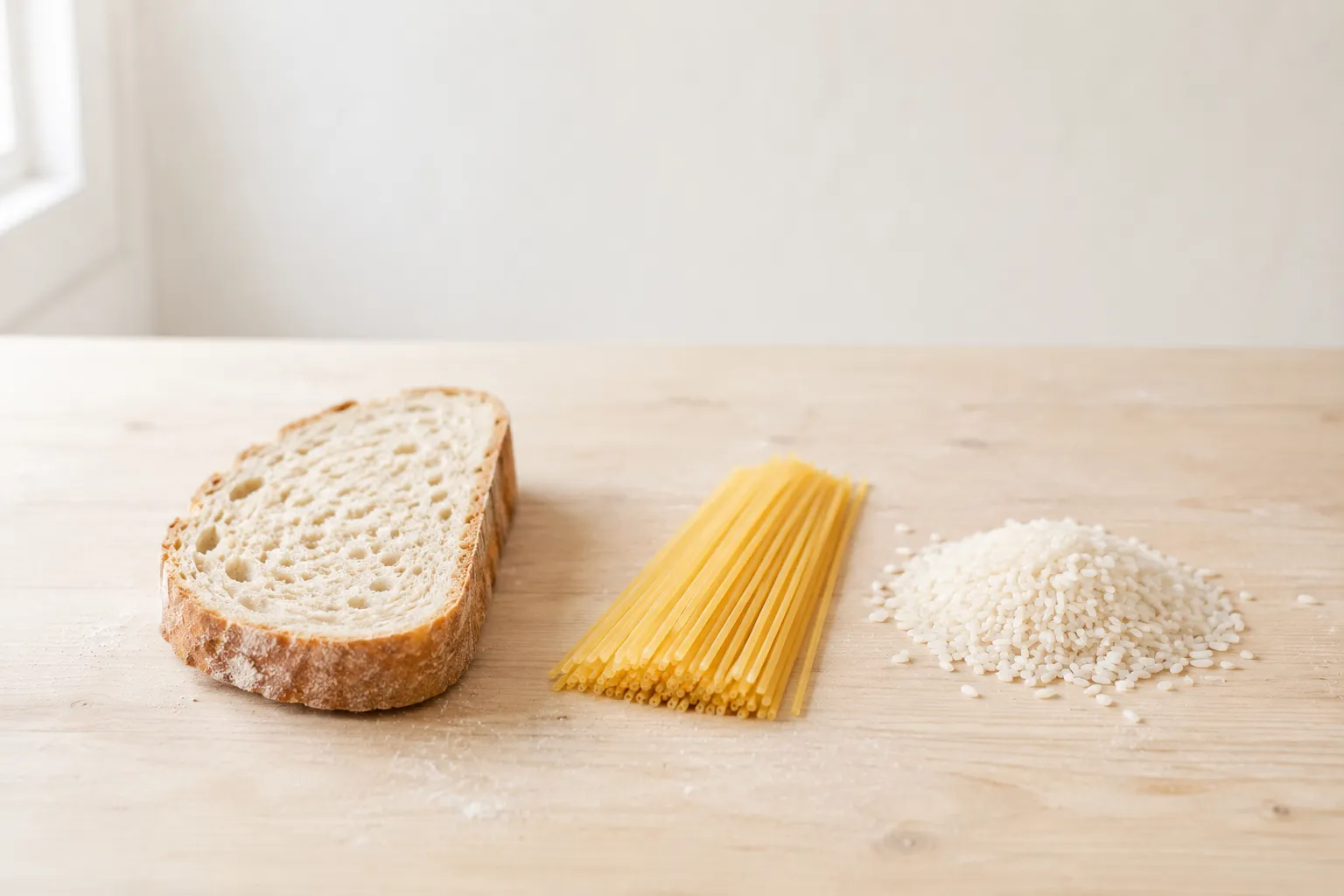
Bread, pasta and rice on light wood

What you’ve been told

“Carbs are why you're gaining weight.”

What’s actually true

A calorie surplus is why you're gaining weight. Not bread. Stanford ran 609 people on low-carb or low-fat for a year. The difference between the two groups was a pound and a half.

Gardner et al. · JAMA, 2018
A worn pair of everyday shoes on a pale floor in daylight

What you’ve been told

“I can't lose weight, I have a slow metabolism.”

What’s actually true

Your metabolism probably isn't the variable. Between two people of the same size, what moves the needle is everything you do without noticing. Fidgeting, stairs, standing, walking to the car. That gap runs to 2,000 calories a day.

Levine · Journal of Internal Medicine, 2007

A true claim and a false claim can arrive looking almost identical.

Just Eat Right gives you somewhere to put the answer.

The claim.
The reasoning.
The evidence behind it.
All in one place.

Here's one you can check in your own kitchen, right now.

Find any box that says “made with whole grains.” Turn it over and read the first ingredient.

Go on. I'll wait.

Whole grains only have to appear somewhere on that list. Fifth, behind refined flour and sugar, still counts. The claim is true. The food is still junk.

Sounds healthy. Isn't. Nobody lied to you. That's why it works.

That's the difference between being given nutrition advice and knowing how to use it.

Get Instant Access $97 once  ·  Lifetime access  ·  60-day refund
The author of Just Eat Right, photographed at 36
This is me at 36.
The same author, also at 36, twenty years after the bloodwork
So is this. No supplements, not even a multivitamin. Bloodwork better now than at 16.
Why I Made This

I was 16 when the bloodwork came back.

High cholesterol. Vitamin deficiencies across the board. Numbers that had no business being in a teenager's chart.

I sat there not believing it. This was supposed to happen when you were sixty, not before you could legally drive.

I was also eating terribly. Costco runs every couple of weeks, cart full of Cheez-Its, chips, cookies, processed everything. I felt like garbage most days and figured that was just being a teenager.

The bloodwork scared me. Not the feeling bad. The numbers.

So that night I started reading. And I didn't stop.

Primary research. Peer-reviewed studies. Anything with real evidence behind it. Then I changed what I was eating and tracked what happened, including how I felt and what the next round of bloodwork showed.

Year after year.

What I found was that nutrition was far more complicated than the rules I'd been hearing. Some things I'd assumed were healthy weren't. Some things I'd been told to avoid weren't nearly as bad as I'd thought.

Once I understood that, everything changed.

My labs turned around. My fitness reached a level I couldn't have imagined at 16.

Not because I found the perfect diet. Because I finally understood what I was putting in my body and why it mattered.

20 years later, after spending my life learning this, testing it, questioning it, and living it, I built the resource I wish I'd had when I was 16.

That's Just Eat Right.
What It Is

A reference, not a program.

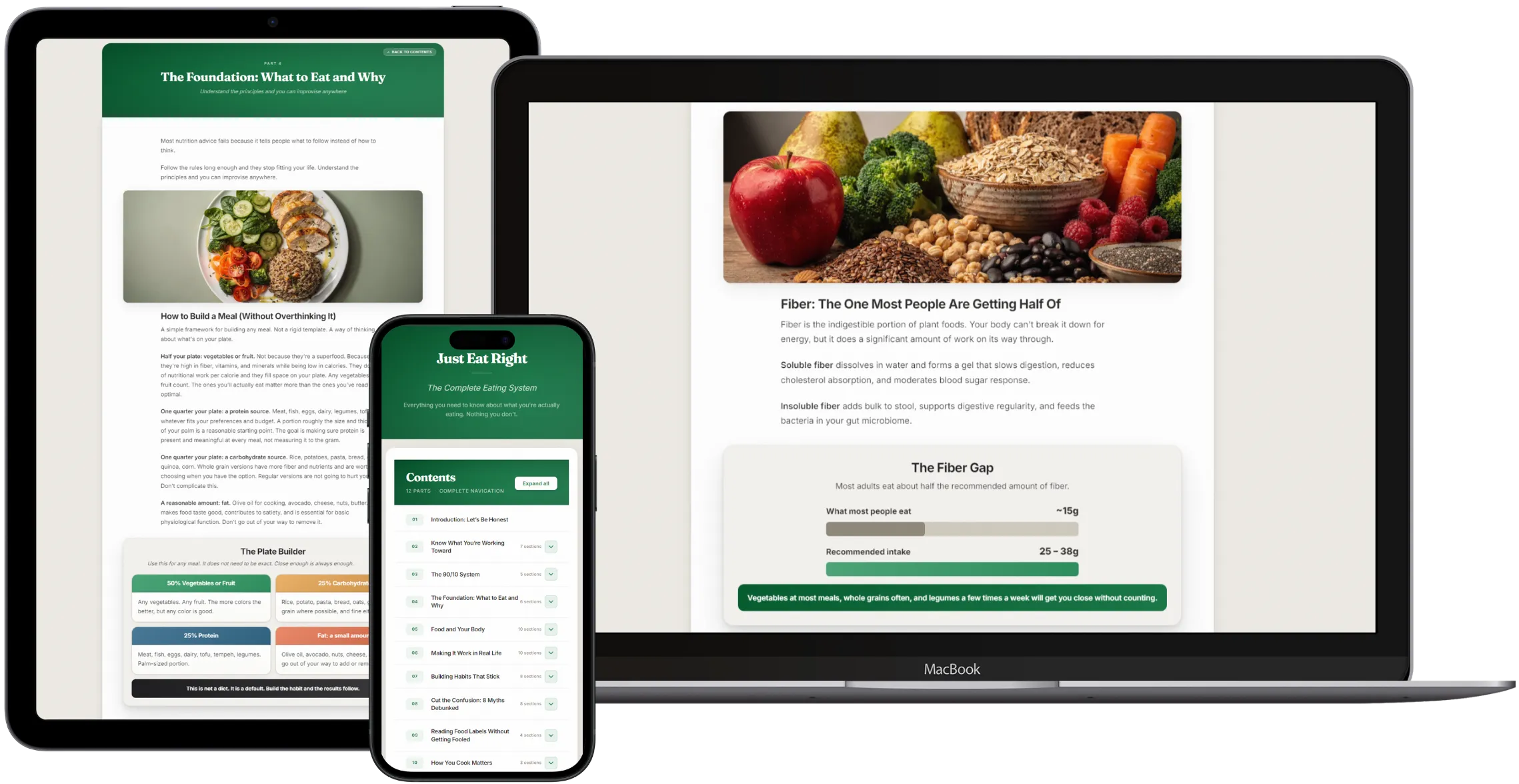
It isn't a PDF and it isn't a 30-day plan. It's an interactive guide that opens in your browser and stays open. The thing you come back to, not the thing you finish.

Standing in an aisle deciding between two labels. Sitting at a restaurant table. Halfway through a Tuesday when you've got ten minutes and nothing thawed.

You don't complete it. You use it.

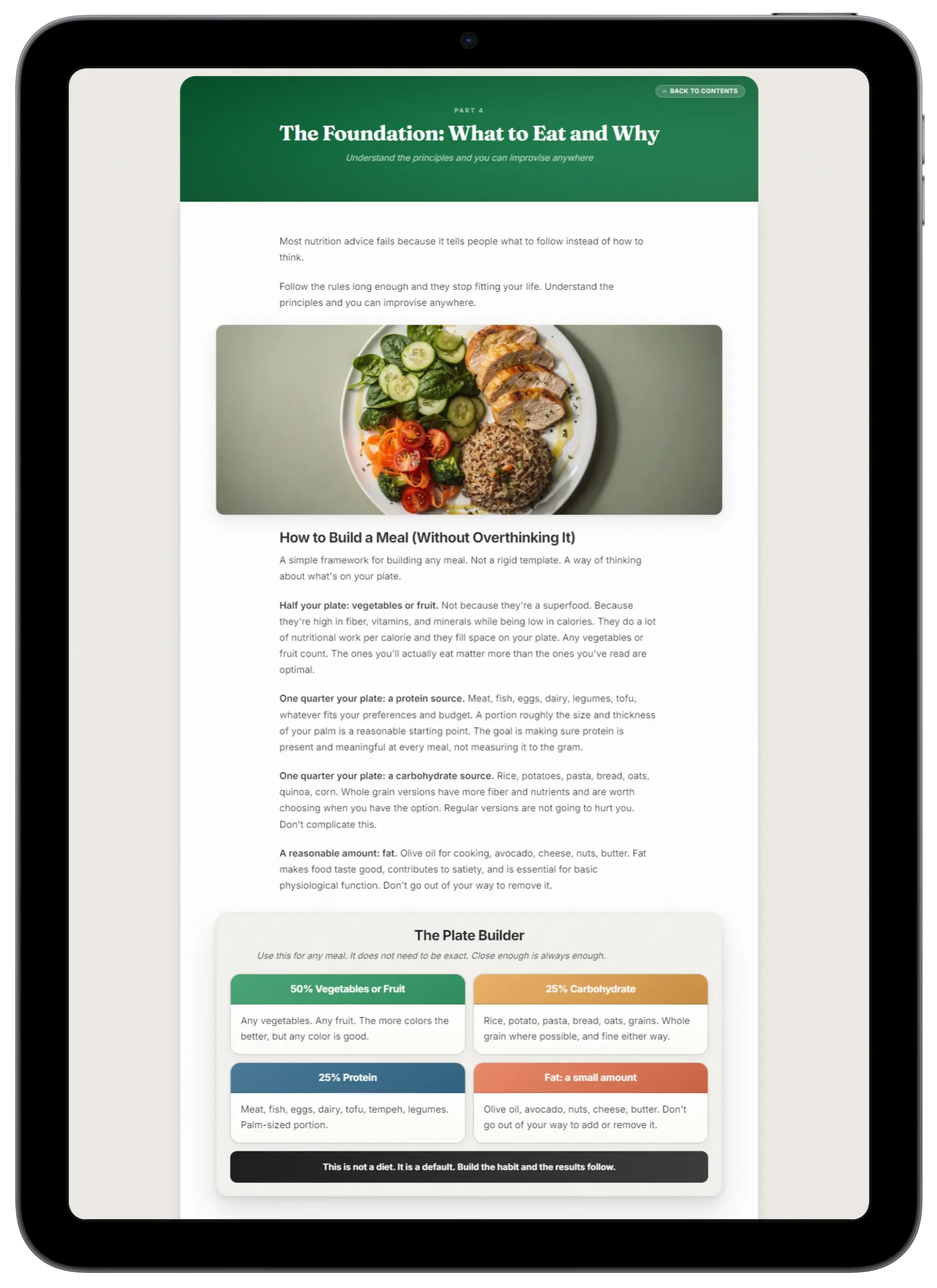
Just Eat Right open on a tablet
  • Searchable. Type what you’re wondering about and land on the answer in seconds. In the aisle, on your phone, while the person behind you waits.
  • Built to be used, not read through. 53 charts, swaps, grids and decision trees. Including the meal grid that turns four columns of eight ingredients into 4,096 different meals.
  • Works on anything you own. Phone, tablet or laptop. No app to download, no login, no subscription to forget about.
  • It tells you where to start. The 6-Week Build: one change a week, in order, until you stop having to think about it.

Twelve parts. Here’s what’s in each one.

12Parts
64Sections
53Built-in tools
43Cited studies
Click a part to see inside
Tap a part to see inside
Get Instant Access $97 once  ·  60-day refund  ·  Keep the guide either way
Who This Is For

Some people should buy this. Some really shouldn’t.

This was written for you if:
  • The advice changes every year.One expert says eat it. The next says avoid it. Both sound sure.
  • You want to know what matters.Not another list of 47 approved foods. A way to decide for yourself.
  • You still guess in the aisle.You read the front of the box and still don’t know what’s in it.
  • Knowing it isn’t the problem.You don’t need more rules. You need something that survives a Tuesday.
  • You want to work it out yourself.So the next confident expert doesn’t send you back to square one.
Don’t buy it if:
  • You want a locked seven-day menu.You get the plate builder, swaps and a sample week. Not a schedule.
  • You want nothing to change.There’s room for the food you won’t give up. Not room for all of it.
  • You want someone checking in.Nobody is. It’s yours the moment you buy it, and so is the work.
  • You want an app that reminds you.No login, no streaks, no notifications. It’s a reference you open.
  • You’ve already made your mind up.Three things in here contradict advice you trust. I won’t soften them.
The Offer

Twenty years of figuring out what actually matters about food. Built into something you can use.

Just Eat Right open on a phone, tablet and laptop 60-Day Money Back Guarantee
Instant Access

Just Eat Right

$97 One-time payment · Lifetime access
  • Find the answer in seconds, not sessions. 64 searchable sections across 12 connected parts
  • Know where to start. The JER Score takes two minutes and points you at the sections that matter for you
  • Change it without willpower. The 6-Week Build gives you one habit a week until it is automatic
  • Decide without guessing. 53 charts, swaps and decision trees for the calls you actually make
  • Build meals from food you already buy. Plate framework, pantry staples, and the meal grid
  • Check my work. 43 sources, named and dated, so you can go read the evidence yourself
  • Open it anywhere. Phone, tablet or laptop. No app, no login, nothing to remember
Get Instant Access Secure checkout powered by Stripe

Take 60 days. Then decide.

Take the JER Score. Run the 6-Week Build. Search it when you're standing in a grocery aisle. Open it when you're staring at a menu. Use it on the nights you can't be bothered to cook.

Any time in the first 60 days, if you don't think it was worth $97, email me and I'll refund every cent. No form. No reason required. No follow-up pitch. Keep the guide.

FAQ

Quick answers.

I already know most of this. Do I need it?

Possibly not, but knowing isn't usually the problem. What you know arrived in fragments, from different people, in whatever order the algorithm picked, and none of it came with a way to tell which fragments survive scrutiny. This is the whole subject laid out in order, with the reasoning under each piece and the studies attached, so you can work out what to do in situations nobody ever made a clip about.

Is this a meal plan? Will I have to count anything?

No. There are no prescribed meals and no daily schedule. You get a framework for building any meal out of food you already eat, plus the reasoning behind it. There's a sample week in there to show what it looks like in practice, not to tell you what to eat on Tuesday.

There's one number in the whole system, and the number is two. The 90/10 System runs on 21 meals a week: 19 built the way the guide describes, 2 that are whatever you want. No calories, no grams, no macros, nothing weighed. The guide explains how calories work because you should understand that rather than be kept in the dark, but nothing in the system runs on tracking. The plate framework is deliberately approximate. Its actual instruction is that close enough is always enough.

Is this another low carb thing?

No, and it's the first thing the guide argues with. Myth number one in the myths chapter is “carbs make you fat,” and it goes straight at what the research shows when protein and calories are controlled for. The argument here isn't low carb. It's low processed. Those are not the same thing and confusing them has cost a lot of people a lot of years.

Isn't eating well expensive?

The premium version is. Organic supermarkets, cold-pressed juice, grain-free snack bars, yes, that adds up. The basic version doesn't. There's a budget matrix built from eighteen cheap staples (eggs, canned beans, lentils, rice, oats, potatoes, frozen vegetables, cabbage and the rest) that produces 216 meal combinations, all under three dollars a serving.

That narrative survives because the expensive version is the one that gets photographed.

What happens when I stop following it?

You will, at some point, and so does everyone. The system is built for it rather than surprised by it, which is most of the reason it survives past week three. There's a section on handling setbacks and a separate one on why the streak mindset is the thing that quietly ends most attempts. Both are worth reading before you need them.

Where do I start once I buy it?

With the JER Score. It takes two minutes, flags the areas most worth your attention, and links you straight to the sections that cover them. You don't read 64 sections front to back. You start where your own answers say to start.

What do I actually get, and what if I hate it?

Not a PDF. It's an interactive guide that opens in your browser on a phone, tablet or laptop. Twelve parts, sixty-four sections, fully searchable, with the JER Score built in so you can retake it and watch the number move. No app to download, no login, no account. You get a link and it's yours, including any future updates.

And if it isn't for you, sixty days, no questions asked. Email me, I refund it, you keep the guide. No form to fill in, no “what went wrong,” no follow-up pitch.

One Last Thing

You could keep searching for the answer every time. Or you could have the answer waiting for you.

Just Eat Right puts 20 years of learning, 64 sections, 53 decision tools, and 43 studies you can go read yourself into one reference you search whenever you need it, with a system underneath so it doesn't become one more thing you read once and forgot.

Just Eat Right open on a laptop and phone Get Instant Access
Instant access
·
60-day refund
·
No app
·
Works on any device