


Noise pollution health effects are bigger than most people think.
Most people think of noise as an annoyance. Your neighbor is loud, traffic is annoying, the subway is screaming, somebody is drilling at 7 a.m.
You put up with it and move on.
But your body does not necessarily just ignore it.
Long-term environmental noise exposure has been associated with sleep disruption, hearing impairment, cardiovascular effects, metabolic effects, cognitive problems, and mental-health effects. The World Health Organization considers environmental noise a significant public-health issue.
And that is what makes this different from simply being annoyed by your surroundings.
The Short Answer
Yes, chronic noise can affect your health even when you feel like you have gotten used to it.
Your brain does not need to consciously think, “This noise is stressing me out,” for your body to respond to sounds around you. Environmental noise can interfere with sleep and activate physiological stress pathways, while repeated loud exposure can directly damage hearing.
The problem is that a lot of this exposure is happening in the background.
Traffic.
Aircraft.
Trains.
Construction.
Sirens.
You might barely notice it anymore. Your body still might.
You Can Get Used to Noise Mentally, But Your Body Still Responds
That is the trap.
You can become accustomed to a sound without that meaning the sound has stopped affecting you.
Noise exposure can interfere with sleep and trigger physiological responses involving stress systems, particularly when the exposure is persistent or happens at night.
And most people are not dealing with one giant noise event. They are dealing with a constant background load.
Traffic outside your apartment.
A train passing every few minutes.
Aircraft overhead.
Construction next door.
A loud workplace.
Then you go home and your bedroom is not actually quiet either. That is where the problem starts to add up.
Hearing Loss Is the Obvious Problem

Your ears get hit first.
Sound travels through the ear and ultimately reaches the cochlea, where specialized sensory cells convert sound vibrations into signals your brain can interpret. Repeated exposure to sufficiently loud sounds can damage those sensory cells, and noise-induced hearing loss can become permanent.
And the louder the sound, the less time it takes to become dangerous.
That is why a normal conversation is not the same thing as standing next to industrial machinery or a jet engine.
There also is not one simple number where noise suddenly becomes “safe” or “unsafe.” Duration matters too. NIOSH uses an occupational exposure limit of 85 dBA averaged over an 8-hour workday, with allowable exposure time decreasing as sound levels increase.
So do not think of decibels as a simple on/off switch.
Louder + longer = more risk.
Your Brain Does Not Just Turn Noise Off
This is where noise gets more interesting.
Your brain is constantly processing your environment, including sounds you are not consciously paying attention to.
Persistent environmental noise can interfere with sleep and activate physiological stress pathways. WHO evidence reviews specifically identify stress-related mechanisms as part of the way environmental noise can affect cardiovascular and metabolic health.
You do not necessarily need to feel consciously stressed for your body to respond.
That is important.
Because if you live next to a busy road, you are not deciding every night:
“Time to activate my stress response.”
The noise is just there.
Noise Can Affect Mental Health Too
The relationship between noise and mental health is more complicated than simply saying “noise causes depression.”
But there is evidence of an association.
A systematic review and meta-analysis of traffic noise found that aircraft noise was associated with about a 12% increase in depression risk per 10 dB increase in exposure. Evidence for road and railway noise was weaker and less consistent.
That is an important distinction.
There is evidence.
It is not equally strong for every type of noise or every mental-health outcome.
So I would not tell you that living on a busy road is going to give you depression.
But I also would not pretend the noise is completely irrelevant.
Sleep Is Probably the Biggest Immediate Problem
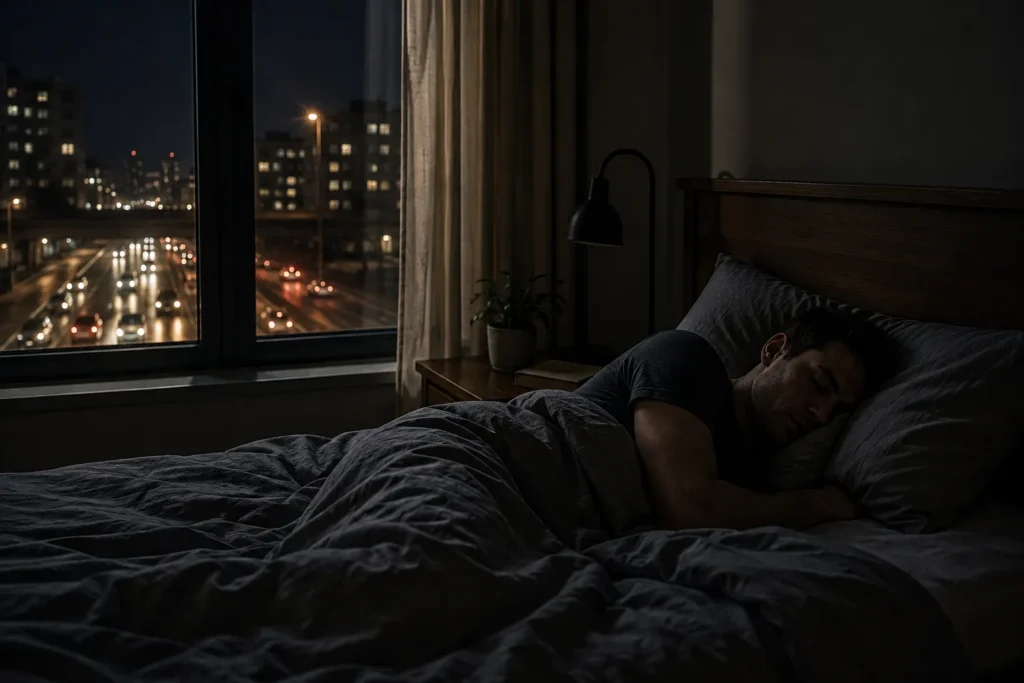
This is where everyday noise becomes really obvious.
Your ears do not shut off because you went to sleep.
Your brain is still processing sounds around you, and environmental noise can cause awakenings, disturb sleep quality, and make it harder to get the recovery you are supposed to be getting at night. WHO specifically recommends lower nighttime road and aircraft noise levels because of their association with adverse sleep effects.
And sleep matters for basically everything.
Mood.
Cognition.
Metabolic health.
Recovery.
Performance.
So if your bedroom is next to a six-lane highway, fixing that noise problem is probably more useful than buying another supplement.
Your Heart Gets Dragged Into It Too

This is not just a hearing story.
Long-term transportation noise has been associated with cardiovascular disease, and WHO identifies cardiovascular and metabolic effects among the major health outcomes associated with environmental noise.
The proposed mechanism makes sense.
Repeated noise exposure can interfere with sleep and activate stress-related physiological pathways. Over long periods, those pathways can contribute to cardiovascular and metabolic problems.
Again, though:
Association does not mean every person exposed to traffic noise is going to develop heart disease.
It means noise is another environmental exposure worth taking seriously.
Noise Pollution Is Also Expensive
Here is something I did not expect when I started looking into this.
A 2025 NBER study estimated that traffic noise creates roughly $110 billion in economic costs across the United States. The researchers also found that the burden is not distributed equally, with lower-income households carrying a disproportionate share of the cost.
So this is not just some rich-person complaint about wanting a quieter neighborhood.
Noise pollution is a real environmental externality.
And the people who have the least ability to move away from it can end up dealing with the most exposure.
Even Hospitals Can Be Too Loud

This part says a lot.
Hospitals are supposed to be places where people recover.
Yet hospital environments can be surprisingly noisy, with alarms, equipment, conversations, carts, doors, visitors, and emergency activity creating substantial background noise.
That is a problem because patients are already trying to sleep and recover while they are there.
The WHO specifically recognizes sleep disturbance, cognitive effects, cardiovascular effects, and other health consequences from environmental noise.
So if you are lying in a hospital bed trying to recover while alarms are going off all night, it is not exactly an ideal sleep environment.
The 5 most toxic items in your bathroom, kitchen, and bedroom.
Find out which to fix first, free.
Instant access. No account needed.
What About Pregnancy and Other Health Effects?
Noise exposure is also being studied in relation to pregnancy and other reproductive outcomes.
The evidence here is not as straightforward as the evidence for sleep, hearing, or cardiovascular effects, so I would not make some ridiculous claim that every noisy environment is damaging a pregnancy.
But adverse birth outcomes are one of the health outcomes included in WHO’s environmental-noise evidence base.
That tells you something important:
Researchers are not just studying whether noise is annoying.
They are studying whether chronic environmental exposure has measurable biological consequences.
What Can You Actually Do About Noise Pollution?
Start with your bedroom.
Seriously.
If you cannot control the noise during the day, at least try to make the place where you are supposed to recover as quiet as possible.
Close windows when outside noise is high. Improve the room’s insulation if you can. Use curtains, seals, and other practical methods to reduce sound entering the room.
White noise or other masking sounds can also help some people deal with unavoidable background noise.
Then look at the rest of your exposure.
If you work around loud equipment, use appropriate hearing protection.
If you regularly use loud machinery, do not stand next to it unnecessarily.
If you have the option of taking a quieter route or avoiding the loudest parts of your commute, that is another easy reduction.
You do not have to move into the woods and wear noise-canceling headphones for the rest of your life.
Just lower the dose where you can.
The Real Solution Is Not Just Personal
Here is the bigger problem.
You can protect yourself to some degree.
But you cannot individually fix bad building insulation, highways running through residential neighborhoods, aircraft routes, or poorly designed city infrastructure.
That is why noise pollution is a public-health problem too.
WHO recommends reducing transportation noise at the source and along the route between the noise source and the people exposed to it.
Quieter roads.
Better buildings.
Better urban planning.
Better transportation systems.
Those things matter.
The Takeaway
Noise is not just annoying.
Long-term exposure can interfere with sleep, damage hearing at high enough exposure levels, activate stress-related pathways, and is associated with cardiovascular, metabolic, cognitive, and mental-health effects.
That does not mean every siren is damaging your body.
It means chronic exposure matters.
So if you live somewhere loud, start with the easiest thing to control:
Your bedroom.
Make it quieter.
Protect your ears around genuinely loud equipment.
And reduce your exposure where you realistically can.
You do not need to become paranoid about noise.
But pretending it does not matter is not exactly smart either.
Frequently Asked Questions
What are the health effects of noise pollution?
Long-term environmental noise exposure can contribute to sleep disturbance, hearing impairment, cardiovascular effects, metabolic effects, cognitive problems, and mental-health effects.
Can noise pollution cause hearing loss?
Yes. Repeated exposure to sufficiently loud noise can damage the sensory structures in the inner ear and cause permanent noise-induced hearing loss. Risk depends on both the loudness of the sound and how long you are exposed.
Can noise pollution affect sleep?
Yes. Environmental noise can disturb sleep and cause awakenings, and nighttime traffic and aircraft noise are specifically recognized by WHO as important sources of sleep-related health effects.
Can noise pollution affect your heart?
Long-term transportation noise has been associated with cardiovascular disease, and WHO identifies cardiovascular effects as an important health consequence of environmental noise.
Can noise pollution affect mental health?
There is evidence connecting some forms of environmental noise with mental-health outcomes. For example, a meta-analysis found aircraft noise was associated with a 12% increase in depression risk per 10 dB increase, although evidence for other transportation noise was weaker.
How loud is too loud?
It depends on both the sound level and exposure time. NIOSH uses 85 dBA as an 8-hour occupational recommended exposure limit, with allowable exposure time decreasing as sound levels rise.
How can I protect myself from noise pollution?
Reduce exposure when you can, protect your hearing around loud equipment, and make your bedroom as quiet as practical. For unavoidable environmental noise, reducing the amount and duration of exposure is the basic strategy.
The Bottom Line
You do not have to hear something consciously for your body to respond to it.
That is the part most people miss.
Noise can interfere with sleep, damage hearing at high enough exposure levels, and contribute to stress-related and cardiovascular effects over time.
So no, you do not need to be scared of every loud noise.
But if you are living next to a highway, sleeping next to a busy street, or spending eight hours a day around loud equipment, it is probably worth doing something about it.
Less noise is better.
That is the lever.
Sources / Research Notes
Key sources: WHO environmental-noise evidence and recommendations; CDC/NIOSH occupational noise guidance; meta-analysis of traffic noise and depression; 2025 NBER analysis of U.S. traffic-noise costs.