


Most health headlines do the same dumb thing.
They take an interesting finding and stretch it into something the study never actually said.
That is what happened with a massive new study on coffee and dementia. Researchers followed 131,821 people for up to 43 years and found that higher consumption of caffeinated coffee was associated with a lower risk of developing dementia. The strongest association was seen at roughly 2 to 3 cups of caffeinated coffee per day.
That sounds pretty good.
But before you start drinking coffee like it is a prescription medication, there is more to it.
Can Coffee Lower Your Risk Of Dementia?
Possibly.
A 2026 study published in JAMA found that people who consumed more caffeinated coffee had a lower risk of dementia than people who consumed little or none. The highest quartile of caffeinated coffee consumption was associated with an 18% lower relative risk of dementia compared with the lowest quartile.
That is a pretty interesting finding.
But there is one word you need to pay attention to:
Associated.
The researchers found a relationship between coffee consumption and dementia risk. They did not prove that drinking coffee prevents dementia.
Those are two completely different things.
What Did The Study Actually Find?
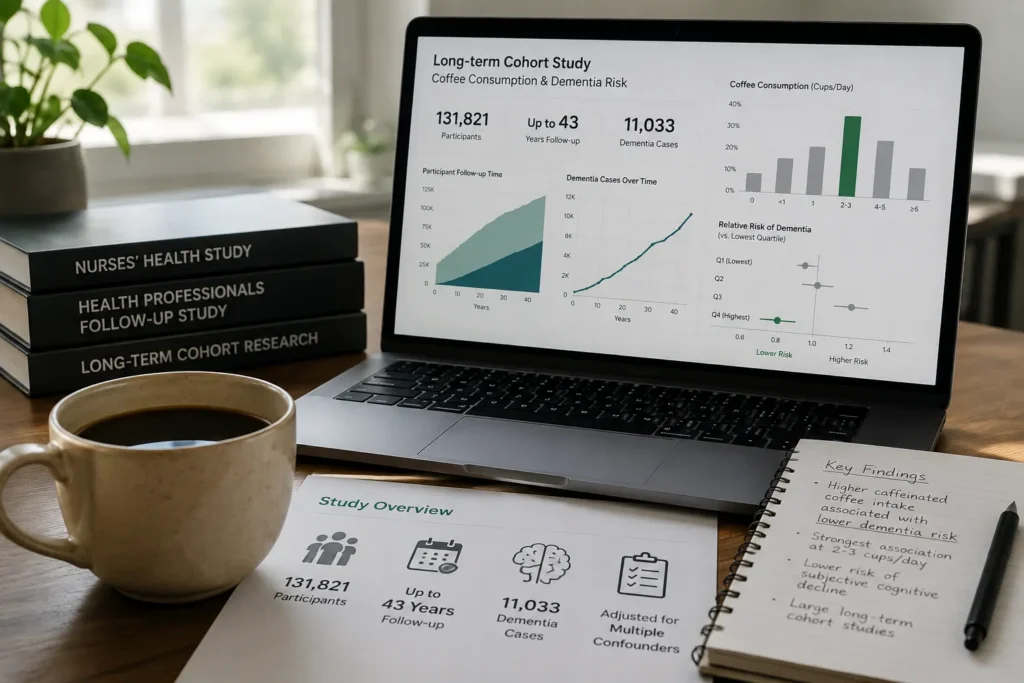
The researchers used data from two large, long-running studies: the Nurses’ Health Study and the Health Professionals Follow-up Study.
Together, they included 131,821 participants and followed them for as long as 43 years. During that period, 11,033 people developed dementia.
After accounting for various potential confounding factors, higher caffeinated coffee intake was associated with lower dementia risk. The researchers also found lower rates of subjective cognitive decline among people drinking more caffeinated coffee.
So this was not some tiny experiment on 30 people.
It was a very large, very long-term observational study.
That is worth paying attention to.
How Much Coffee Is Best For Brain Health?

This is probably the part everyone wants to know.
The strongest associations showed up at approximately 2-3 cups of caffeinated coffee per day. For tea, the strongest associations were around 1-2 cups per day. One cup in the study was defined as 8 ounces.
And before you make the classic mistake of thinking:
“If two cups are good, eight cups must be even better.”
No.
The relationship was nonlinear, meaning the association did not just get stronger and stronger as coffee consumption increased. More was not automatically better.
What About Decaf Coffee?
This is one of the more interesting parts of the study.
The researchers looked at caffeinated and decaffeinated coffee separately. Higher caffeinated coffee intake was associated with lower dementia risk. Decaffeinated coffee was not significantly associated with lower dementia risk.
That does not mean decaf is bad for you.
It also does not prove that caffeine is responsible for the difference. There could be other differences between people who drink caffeinated coffee and people who drink decaf.
But it does make caffeine an interesting possibility.
Why Would Coffee Help Your Brain?

There are a few possible explanations.
Caffeine affects adenosine receptors and changes signaling in the brain. Coffee also contains other compounds that may affect things like inflammation, oxidative stress, blood vessel function, and metabolism.
The study discusses several possible biological pathways that could help explain the association.
But do not make the mistake of thinking:
“We know how it could work, therefore we know it works.”
That is not how science works.
A possible mechanism is not proof that the mechanism actually causes the outcome you are interested in.
It is just an explanation worth investigating.

The 5 most toxic items in your bathroom, kitchen, and bedroom.
Find out which to fix first, free.
Instant access. No account needed.
Does Coffee Improve Memory Too?
There were some interesting findings beyond dementia diagnoses.
People with higher caffeinated coffee intake were less likely to report subjective cognitive decline. In the Nurses’ Health Study, higher caffeinated coffee intake was also associated with slightly better performance on some objective cognitive tests.
But the differences were small.
So do not turn this into:
“Coffee makes you smarter.”
That is not what the study showed.
The researchers found modest differences in some cognitive outcomes, and not every measure was statistically significant.
Interesting?
Yes.
A giant cognitive enhancement?
No.
Does Drinking More Coffee Give You More Protection?
Not according to this study.
The strongest associations were at moderate levels of consumption, and the researchers did not find that more caffeine simply produced proportionally better outcomes.
And there is another obvious problem with pushing caffeine higher: sleep.
If you are drinking so much coffee that you are barely sleeping, I do not care how many studies you found saying coffee might be good for your brain.
You are still barely sleeping.
That is probably not a great trade.
What This Study Does NOT Prove
This is the part most health headlines leave out.
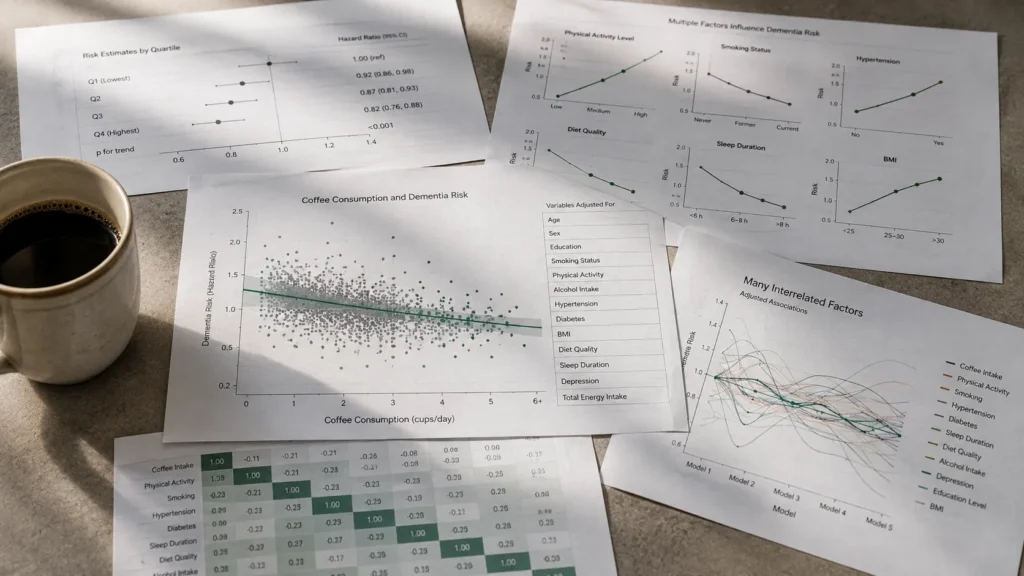
The study does not prove that coffee prevents dementia, that caffeine prevents Alzheimer’s disease, that everyone should start drinking coffee, that more coffee is better, that decaf is bad for you, or that coffee will dramatically improve your memory.
The researchers specifically described this as a prospective cohort study, and observational research cannot completely rule out residual confounding or other explanations for the association.
A similar thing just happened with vitamin D and dementia.
The study also was not designed to determine whether coffee specifically prevents Alzheimer’s disease.
So the scientifically accurate version is pretty simple:
Higher caffeinated coffee intake was associated with lower dementia risk.
That is what we know.
And honestly, that is still interesting enough.
So Should You Drink Coffee?
If you already drink caffeinated coffee, you tolerate it well, and it does not screw up your sleep, this study is pretty reassuring.
The strongest association was seen around 2-3 cups a day.
But I would not start drinking coffee just because you think it is going to prevent dementia. And I definitely would not force yourself to drink more if caffeine makes you anxious or destroys your sleep.
There is not some magical number where you suddenly unlock brain protection.
The Bigger Picture

Dementia is not caused by a lack of coffee.
Your long-term brain health is influenced by a lot of different things, including cardiovascular health, physical activity, metabolic health, sleep, smoking, alcohol, genetics, and probably plenty of other factors.
Coffee might be one small piece of the puzzle.
It is not the entire puzzle.
That is the part people constantly screw up with nutrition. They find one food, one supplement, or one study and suddenly act like they have discovered the secret to human health.
There is not one.
Frequently Asked Questions
Can coffee lower your risk of dementia?
A large 2026 JAMA study found that higher caffeinated coffee intake was associated with a lower risk of dementia. The study did not prove that coffee itself prevents dementia.
How much coffee should I drink for brain health?
The strongest associations in the study occurred at approximately 2-3 cups of caffeinated coffee per day. That does not mean everyone should drink that amount.
Is decaf coffee good for dementia?
Decaffeinated coffee was not significantly associated with lower dementia risk in this study. That does not mean decaf is unhealthy.
Does caffeine prevent Alzheimer’s disease?
This study examined dementia overall and did not establish that caffeine prevents Alzheimer’s disease specifically.
Is more coffee better for your brain?
No. The study found a nonlinear relationship, with the strongest associations occurring around moderate consumption rather than continuously increasing with higher intake.
Does coffee improve memory?
Higher caffeinated coffee consumption was associated with lower subjective cognitive decline and slightly better performance on some cognitive tests, but the differences were modest and do not prove that coffee makes people significantly smarter.
The Takeaway
A huge study followed 131,821 people for up to 43 years and found that higher caffeinated coffee consumption was associated with a lower risk of dementia.
The strongest association was around 2-3 cups a day.
That is interesting.
It is not proof that coffee prevents dementia.
So yes, your daily coffee might be doing more than waking you up.
Just do not start treating your coffee mug like medicine.
Sources / Research Notes
JAMA. Coffee and Tea Intake, Dementia Risk, and Cognitive Function. doi:10.1001/jama.2025.27259.