


Your genes are not a life sentence.
They matter. A lot.
But having a certain gene does not mean your body is automatically going to behave one specific way forever. Your environment and lifestyle can influence how certain genes are expressed, which is one reason researchers pay so much attention to something called epigenetics.
And that is where your daily habits come in.
Sleep. Exercise. Food. Stress. Social connection.
These are not just things that affect how you feel today. They can also change the biological signals your body is dealing with over and over again.
First, Your Habits Do Not Change Your DNA
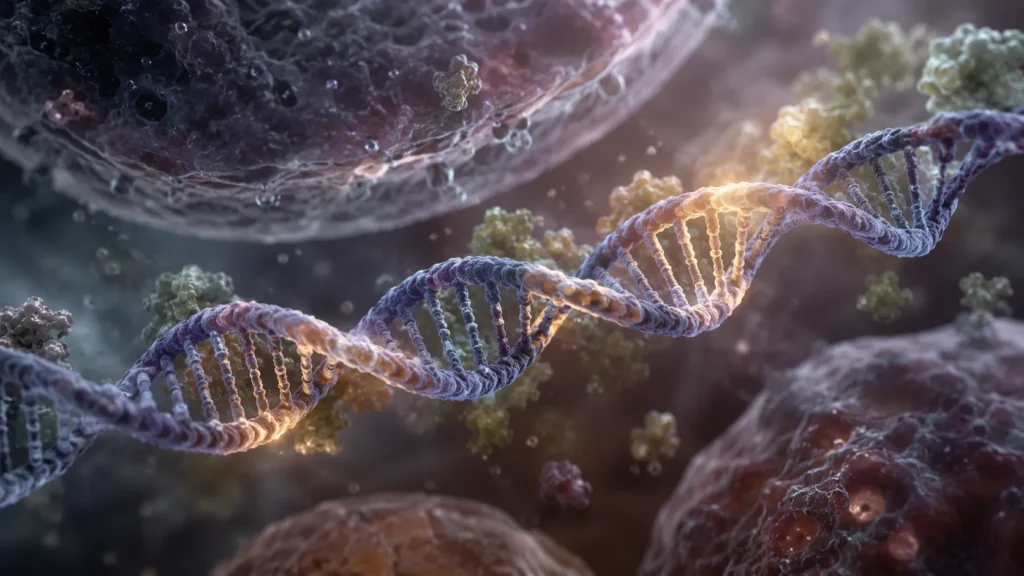
Eating broccoli is not rewriting your genetic code.
Going to the gym is not changing the letters of your DNA.
What your lifestyle can influence is gene expression – basically, which genes are more or less active in particular cells and tissues.
Epigenetic mechanisms such as DNA methylation, histone modifications, and other forms of gene regulation help control that activity. These systems respond to environmental signals, including things like nutrition, physical activity, sleep, and stress.
Think of your DNA as the instruction manual. Your habits can influence which instructions your body is actually using.
That is the basic idea.
1. Get Enough Sleep

If you want one habit that affects a ridiculous number of things, start here.
Sleep is not just the time when you are unconscious doing nothing. Your body is still actively regulating hormones, metabolism, immune function, and a bunch of other processes while you are asleep.
And researchers have actually seen sleep loss change gene expression.
One human study had people go through a week of insufficient sleep and found that 711 genes were up- or down-regulated. The affected genes and pathways were involved in circadian rhythms, immune responses, inflammation, stress responses, metabolism, and gene regulation itself.
Another human experiment found that partial sleep restriction altered expression of 117 genes, including many involved in immune function.
So when you constantly cut your sleep short, you are not just making yourself tired. You are changing the biological environment your cells are operating in.
That is a pretty good reason to stop treating sleep like the thing you do after everything else is finished.
For most adults, a reasonable target is 7-9 hours a night, along with a relatively consistent sleep schedule.
You do not need some perfect nighttime routine. Just stop acting like four hours of sleep is a personality trait.
2. Move Your Body Every Day

Exercise is another biological signal.
Your muscles do not just move when you exercise. They release signaling molecules and respond to changes in energy demand, blood flow, hormones, and metabolism.
Researchers have found that exercise can produce changes in gene expression and DNA methylation in human tissues.
In one study, researchers examined human adipose tissue before and after endurance training and found that training altered the transcriptomic and epigenetic response to exercise.
That is important because it shows that exercise is not simply burning calories.
Your cells are responding to the fact that you are asking them to do something.
And they adapt.
That is basically the whole point of training.
You give your body a repeated signal.
Your body adapts to the signal.
You do not need to train like an athlete to get the benefit.
The current U.S. physical-activity guidelines recommend at least 150-300 minutes of moderate aerobic activity per week, plus muscle-strengthening activity on at least 2 days per week.
Walking counts.
Cycling counts.
Swimming counts.
Lifting weights counts.
The important part is that you actually do it.
3. Eat More Plants

This one gets overcomplicated.
You do not need some obscure “epigenetic superfood.”
Plants already give you plenty of compounds your body can use.
Fruits, vegetables, beans, nuts, seeds, and whole grains contain things like polyphenols, flavonoids, fiber, and other bioactive compounds. Researchers are studying how some of these compounds interact with pathways involved in gene expression and epigenetic regulation.
Polyphenols, for example, can influence processes including DNA methylation, histone modification, and microRNA activity in experimental and some human research.
That is interesting.
But here is the part people screw up:
A food affecting gene expression in a cell does not automatically mean eating that food will prevent a disease.
That is a giant leap.
Human nutrition is much more complicated than that.
So the practical takeaway is simple.
Eat more plants.
Get more variety.
Eat more whole foods.
You do not need to know which microRNA broccoli is influencing before you eat it.
4. Get Your Stress Under Control

Because stress is not just something happening in your head.
Your body responds to it.
When you are under psychological stress, your nervous system and hormone systems change. Researchers have found that acute stress can alter inflammatory signaling and gene expression in human blood cells.
Chronic stress has been associated with changes in inflammatory gene-regulation pathways too. In one study, chronically stressed caregivers showed increased expression of genes associated with the pro-inflammatory transcription factor NF-kB and reduced expression of genes involved in glucocorticoid signaling.
That is not saying:
“Stress turns on your disease genes.”
That is way too simplistic.
It means your body is responding biologically to repeated stress signals.
And that is why learning how to regulate stress is useful.
Go for a walk.
Exercise.
Take some slow breaths.
Meditate.
Get outside.
Talk to somebody.
Whatever actually works for you.
The goal is not to become a monk who never experiences stress.
That is impossible.
The goal is to stop living like your nervous system is permanently being chased by a bear.
5. Stay Connected to Other People

This one gets ignored because people think health means food and exercise.
It does not.
Humans are social animals, and social experiences can affect biological processes too.
Research has found associations between social factors such as loneliness and the expression of inflammation-related genes.
For example, a study of 1,264 adults found that loneliness and chronic social burden were associated with changes in the expression of genes involved in inflammation, although some of the more detailed associations became weaker after statistical adjustment.
Other experimental research has also found that sensitivity to social disconnection can influence inflammatory responses and the expression of genes involved in immune regulation.
So yes, having people in your life matters.
Go do something where other human beings actually exist.
Social connection is not some optional luxury you add after taking care of the “real” health stuff.
It is part of the environment your body lives in.
The Important Part: Repetition
This is what ties all five habits together.
Your body is constantly receiving signals.
One bad night of sleep is not going to permanently screw up your genes.
One workout is not going to transform your biology.
One healthy meal is not going to fix 20 years of bad eating.
But your body is responding to your environment over and over again.
That is why habits matter.
The signal gets repeated.
And repeated signals give your body something to adapt to.
Exercise is a signal.
Sleep is a signal.
Food is a signal.
Stress is a signal.
Social interaction is a signal.
Your body does not experience your lifestyle as five separate health categories.
It experiences the whole thing.

The 5 most toxic items in your bathroom, kitchen, and bedroom.
Find out which to fix first, free.
Instant access. No account needed.
This Does NOT Mean You Can “Turn Off Bad Genes”
This is where the internet gets carried away with epigenetics.
You will see people claiming that you can simply change your genes with your thoughts, diet, or supplements.
No.
That is not what this means.
Your lifestyle can influence gene expression and other biological pathways, but that does not mean you can flip a switch and eliminate the effects of every genetic risk you have.
Genes still matter.
Some genetic variants have enormous effects.
Other traits are influenced by hundreds or thousands of genetic differences plus environmental factors.
The relationship is complicated.
But complicated does not mean your habits do not matter.
It means your habits are one part of the system.
So What Should You Actually Do?
Do not overthink this.
Sleep enough.
Move your body.
Eat more whole plant foods.
Manage chronic stress.
Stay connected to people.
That is it.
You do not need a $200 “epigenetic reset.”
You do not need some bizarre supplement stack.
And you do not need to spend three hours a day optimizing which gene pathways you are supposedly activating.
Start with the boring stuff.
The boring stuff works.
The Takeaway
Your DNA is not constantly being rewritten by what you eat or how much you exercise.
But your body is not a static machine either.
Your environment and your habits can influence gene expression, epigenetic regulation, and the biological pathways operating inside your cells. Research has demonstrated these effects across areas including sleep, exercise, nutrition, stress, and social experience, although the strength of the evidence varies depending on the specific mechanism and outcome.
So do not think:
“My genes determine everything.”
Think:
“My genes are part of the equation, and what I do every day is part of it too.”
You do not need a perfect routine.
You need better daily signals.
Frequently Asked Questions
Can lifestyle change your genes?
Your lifestyle does not normally rewrite the DNA sequence you are born with. However, lifestyle and environmental factors can influence gene expression and epigenetic regulation, which affects how genetic instructions are used by cells.
What is gene expression?
Gene expression is the process through which information in a gene is used to produce RNA and, ultimately, functional proteins or other biological products. Gene expression can be turned up, turned down, or regulated in different ways depending on the cell and its environment.
What is epigenetics?
Epigenetics refers to changes in gene regulation that can alter how genes are expressed without changing the underlying DNA sequence. Mechanisms include DNA methylation, histone modifications, and changes involving regulatory RNAs.
Does sleep affect gene expression?
Yes. Human studies have shown that insufficient sleep can alter the expression of hundreds of genes and affect pathways involving circadian rhythms, metabolism, immune function, inflammation, and stress responses.
Does exercise affect gene expression?
Yes. Exercise can change gene expression and epigenetic patterns in human tissues. Research has shown changes in transcription and DNA methylation following exercise training.
Can diet affect gene expression?
Yes. Nutrients and plant compounds can interact with molecular pathways involved in gene regulation and epigenetic processes. However, findings from cellular and experimental research should not automatically be interpreted as proof that a particular food prevents disease in humans.
Does stress affect gene expression?
Yes. Experimental studies have found that psychological stress can alter inflammatory signaling and gene expression in human immune cells. Chronic stress has also been associated with changes in inflammatory gene-regulation pathways.
Can social isolation affect gene expression?
There is evidence of an association between loneliness or social disconnection and changes in inflammation-related gene expression, although the evidence is not perfectly consistent and mechanisms are still being investigated.
Can you turn off bad genes?
Not in the simplistic way this is sometimes described online. Lifestyle can influence the expression of some genes and biological pathways, but it does not allow you to simply erase genetic risks.
What are the best habits for healthy gene expression?
There is not one scientifically proven “gene optimization” routine. Getting enough sleep, exercising regularly, eating a nutrient-dense diet, managing chronic stress, and maintaining meaningful social connections are all reasonable habits that influence biological systems involved in health.
Sources
Key sources: human sleep-restriction and blood-transcriptome studies; exercise and epigenetic research; reviews of nutrition and epigenetic regulation; studies of stress and inflammatory gene expression; research on loneliness/social disconnection and immune-related gene regulation.